CouplesSleepBetter
Real people. Real results. No fluff.
CouplesSleepBetter
Real people. Real results. No fluff.
You are reading: PERSONAL STORIES › Sleep & Breathing Relief
MY PERSONAL STORY
My Husband's Snoring Pushed Us Into Separate Bedrooms for Two Years. Here's What Finally Brought Us Back Together
We tried everything — the strips, the chin strap, the mouthguard, the specialist. Nothing worked until a friend mentioned something so simple I almost didn't bother.

Nicky N.
Semi-retired Caregiver · Elwood, Nebraska · Wife & Grandmother
✍️ Personal Story — Not a Medical Professional
7 min read

Linda C.
Semi-retired Caregiver · Savannah, Georgia · Wife
✍️ Personal Story — Not a Medical Professional
8 min read
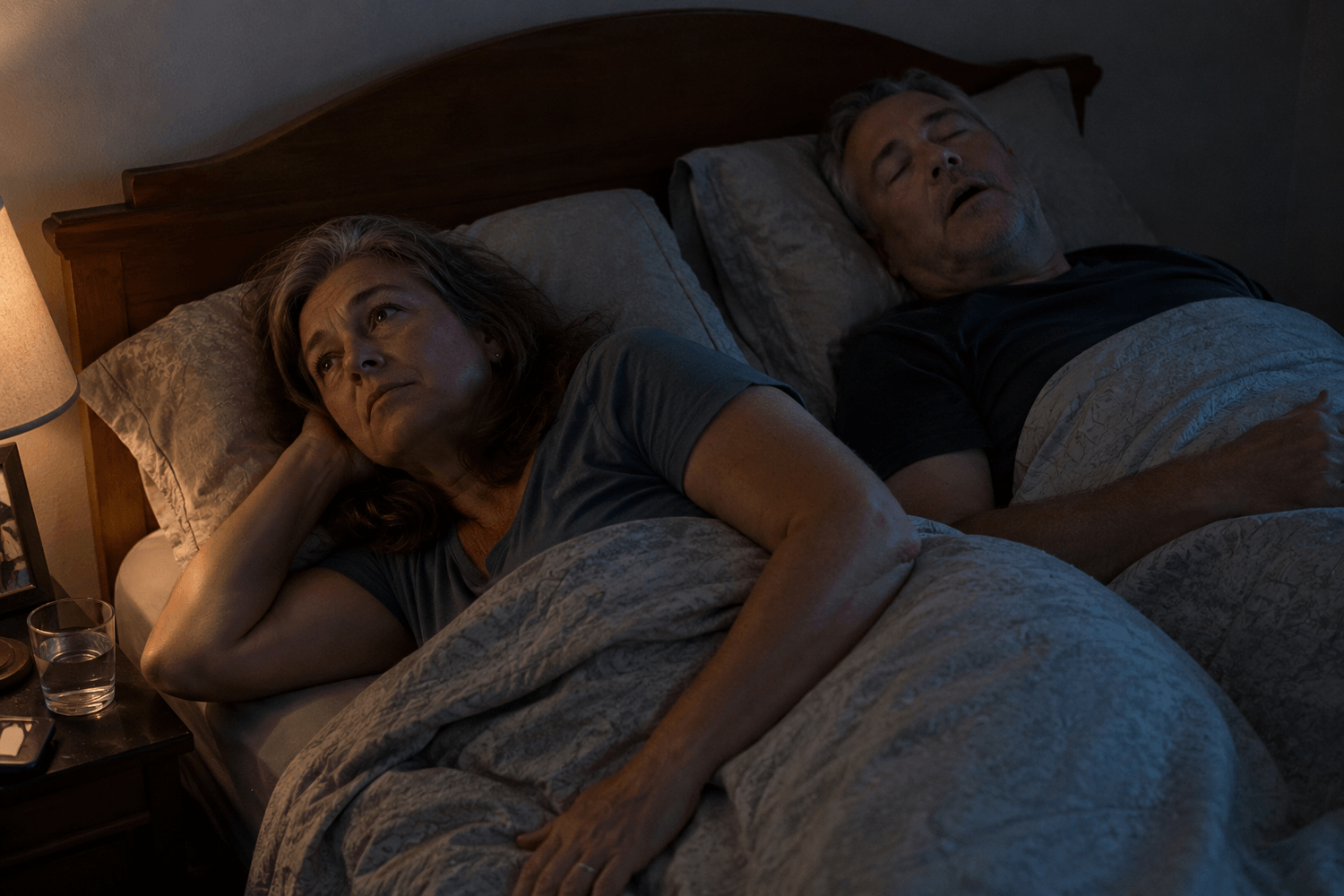
The nightly reality for millions of couples — one person lying awake while the other snores just inches away.
I want to start by saying something I don't hear many people admit out loud:
There was a period of about eight months where I genuinely dreaded going to bed.
Not because I wasn't tired. I was exhausted. But because I knew what was waiting for me the moment my husband fell asleep — a sound I can only describe as a lawn mower trying to start in the next room, coming from the man lying six inches away from me.
My name is Nicky. I'm 55, I live in Nebraska, and I've been married to my husband Will for 26 years. Will is a good man. He's funny, he's kind, he coaches Little League for our grandkids, and he has absolutely no control over the fact that he snores loud enough to rattle the windows.
Or at least, that's what I believed until about five months ago.
If you're reading this in the dark at 11:30pm because the person next to you is keeping you awake — or if you've given up and moved to the guest room — I want you to know that I understand. And I want to tell you what changed things for us.
HOW IT GOT WORSE
Will has snored for most of our marriage. In the early years it was manageable — a background noise I could sleep through with the right position and enough exhaustion.
But somewhere around his late forties it got worse. Significantly worse.
It wasn't just loud. It was unpredictable. Some nights it would stop for twenty minutes and I'd finally drift off — and then it would start again, louder than before, and jolt me straight back awake. I started cataloging the sounds: the low rumble, the high-pitched whistle, the sudden snort that sounded like he was choking.
That last one scared me. I'd shake him awake and he'd be confused, groggy, with no memory of stopping breathing. I started wondering if something was seriously wrong.
The sleep deprivation crept up on me slowly. First I was just tired. Then I was tired and irritable.
Then I was tired, irritable, and starting to feel genuinely resentful — not of Will, because I knew he wasn't doing it on purpose — but of the situation. Of another night of not sleeping. Of another morning of dragging myself to work running on four broken hours.
About two years ago, after one particularly bad week, I moved to the guest room. We told ourselves it was temporary. It lasted eight months.
Those eight months were some of the loneliest of our marriage. Will felt guilty every night. I felt guilty for making him feel guilty.
We were still in love, still good friends, but something about sleeping apart — that nightly closeness, that simple intimacy of being in the same bed — just disappeared. And neither of us knew how to get it back without me not sleeping at all.
WE TRIED EVERYTHING
We didn't just accept it. We tried everything we could think of:
Nasal strips. Will wore them faithfully for six weeks. They helped with the nasal whistling but did almost nothing for the deeper, throat-level rumbling that was the real problem. We wasted $60 on boxes of them.
The chin strap. He wore it twice. Said it felt like someone was holding his mouth shut all night. He couldn't sleep wearing it and gave up.
The mouthguard from the pharmacy. Better — it reduced the snoring maybe 30% on good nights. But it caused jaw soreness that Will said was worse than the snoring itself. After three weeks he stopped using it.
The anti-snore pillow from the drugstore. I don't even remember which brand. It did nothing. I donated it.
Sleeping on his side. This is the classic advice and it genuinely helped — when he stayed on his side. But Will is a back sleeper by nature. The moment he fell into deep sleep, he'd roll back over and the snoring would resume within minutes. I bought one of those positioning wedges you strap around your body to prevent back sleeping. He described it as sleeping inside a life jacket. It lasted four nights.
The sleep specialist. After I moved to the guest room, we finally booked an appointment. The doctor told us something that stuck with me: a lot of Will's snoring had a strong positional component — it got dramatically worse whenever his head fell out of alignment as he slept. She walked us through several options, was honest that the more involved devices have a real adjustment curve and that plenty of people give up on them, and said that for snoring driven by head position, the position itself was worth addressing first. That conversation planted a seed.
THE MECHANISM (THE “AHA”)
A few months later, I mentioned our situation to my friend Deborah at book club. She's one of those people who reads everything and remembers all of it.
That night, Deborah explained something I'd never heard in all our years of trying to fix this — and it finally made the whole thing make sense.
Snoring, she said, is usually a mechanical problem, not a mystery. It comes down to one thing: the position of your head while you sleep.
Think of it like a garden hose. Straight, the water flows freely. Bend it, and the flow chokes down to a trickle. Your airway works the same way:
Head tilted too far back → the airway opens, but your neck strains all night.
Head dropped forward, chin toward your chest → the airway pinches, the throat tissue collapses, and you snore.
Head held in a neutral position → the airway stays open, and breathing stays quiet.
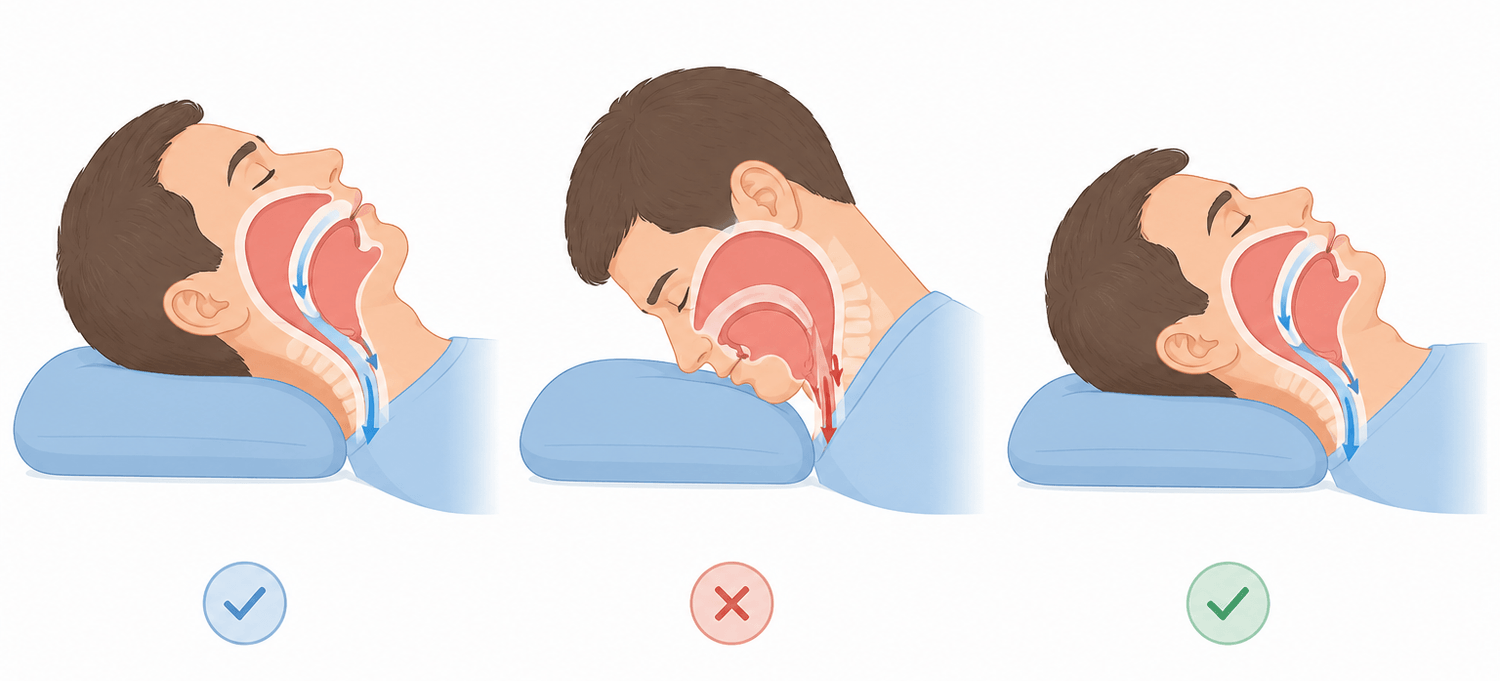
Then she said the part that stopped me cold: most pillows — even the expensive ones — don't hold your head in that neutral position through the night. They feel fine when you lie down, then compress and shift while you sleep, quietly tilting your head out of alignment without you ever knowing.
In other words: you might not be failing to fix your snoring. Your pillow might be causing it.
If that landed the way it landed for me, this is the pillow Deborah was talking about — the one built specifically to hold your head in that neutral position all night long.
THE DECISION TO TRY
She'd read about a pillow specifically engineered for cervical alignment — one with a contoured design that keeps the head in a neutral position whether you're sleeping on your back or your side. She said a couple she knew had tried it and the husband's snoring had reduced dramatically.
I went home and looked it up that same night. I read through the information, read through the reviews, and noticed the 60-day money-back guarantee.
I thought: sixty nights is a long time — longer than I'd stuck with anything else we'd tried. And if it doesn't work, I send it back.
I ordered it the next morning.
😴
The First Two Weeks —
Night by Night
N1
Night 1 — Not sure yet
I actually slept in the guest room this first night — I wanted to give Will a chance to get used to the new pillow without me lying there analyzing every sound.
N2
Night 2 — Quieter than I expected
I came back to our bedroom and lay there in the dark, braced for the usual. The snoring was still there — but maybe half as loud. Not gone. Just softer. I fell asleep before I could overthink it.
N4
Night 4 — The first silent stretch
Around 2am I woke up and realized the room was completely silent. Will was asleep, breathing, quiet. I lay there just listening to the silence — the first time in longer than I could remember that I woke up to nothing at all. The first full night I didn't end up down the hall.
W1
End of Week 1
By the end of the first week I'd slept through 5 of the 7 nights — something that hadn't happened in years. The snoring wasn't gone, but on most nights it was down to maybe a quarter of what it used to be: a low, even breathing I could sleep right through, instead of the start-stop racket that used to jolt me awake.
W2
End of Week 2 — Will noticed it himself
By the second week I was sleeping through 6 nights out of 7. And Will said something that made me laugh and cry at the same time: he didn't realize how badly he'd been sleeping until he started sleeping well. More energy. The brain fog we'd always assumed was just 'him' was lifting. He was in a better mood before coffee — which, if you know Will, is a miracle on its own.
😀
Five Months Later — What's Actually Different
It's been five months. We're back in our bedroom. Together. Every night.
That sounds like it should be obvious. But after eight months in the guest room and years of broken sleep before that, it genuinely felt like something we'd gotten back — something we didn't fully appreciate until we almost lost it.
Will's snoring went from a 9 out of 10 to something I'd call a 1 or 2. There are still nights, usually when he's especially tired or has had a drink at dinner, where I hear it. But it's background noise. The kind I can sleep through. The kind that doesn't send me down the hall at midnight.
He wakes up differently now. He's not groggy for that first hour anymore. He doesn't reach for the extra-large coffee before he can string a sentence together. He's got more patience, more energy — more of himself — in the mornings.
I sleep through the night. Consistently. For the first time in I don't know how long.
And we're closer. I didn't fully realize how much sleeping apart had created a distance between us — not dramatic, not visible, just there — until we weren't apart anymore.
A pillow did that. A pillow and sixty nights of actually believing something might finally work.

“I never realized how much the snoring was affecting our relationship until it stopped. We both sleep better, wake up happier, and honestly feel more like ourselves again.”
😍
The Pillow I Now Recommend to Everyone
The pillow is called Derila Ergo.
What made it work, from what I understand, is the shape. It's not a flat pillow. It has a contoured butterfly design that creates specific support zones for your head, neck, and shoulders. It keeps Will's head in a neutral position — not tilted back, not pushed forward — whether he's sleeping on his back or his side. That neutral position is what keeps the airway open.
The foam holds its shape through the night too. It's not like the memory foam pillows that feel great when you first lie down and are compressed flat by midnight.
It's currently available at a significant discount — less than one session with the sleep specialist — and it has a 60-day money-back guarantee.
If your partner snores and you've run out of ideas, or if you've tried solutions that didn't work and you're at the point where you're considering sleeping in separate rooms — or you're already there — I want you to know that this is worth trying.
We got our bedroom back. I think you can too.

Derila Ergo Memory Foam Pillow
Ergonomic Design
High-Density Foam
70% OFF Today
60-Night Trial
Designed specifically around the principles of cervical alignment, this pillow is currently available with a significant discount and a full 60-day money-back guarantee. Either it works — or you return it and pay nothing.
Ready to Let Your Partner Sleep Again?
The worst case: you return it and pay nothing. The best case: what happened to me.
🔒 Currently 70% OFF + Free Shipping + 60-Night Money-Back Guarantee
I know how it feels to have tried so many things and been let down. The chin strap, the strips, the mouthguard, the pillow wedge — I've been there.
That's why the 60-night guarantee is the only reason I tried this in the first place. Two full months with zero financial risk.
If you're lying awake right now while someone snores next to you, you deserve a real night's sleep.
✓ Free Shipping · ✓ 60-Day Guarantee · ✓ Secure Checkout
Disclosure: This post may contain affiliate links. I may receive a small commission if you purchase through my links, at no additional cost to you. My experience and opinions are entirely my own. This is not medical advice — please consult your doctor about snoring or any sleep-related breathing concerns.
© 2026 therestrecoverylab.com · Independent Sleep & Wellness Research · Privacy Policy · Affiliate Disclosure